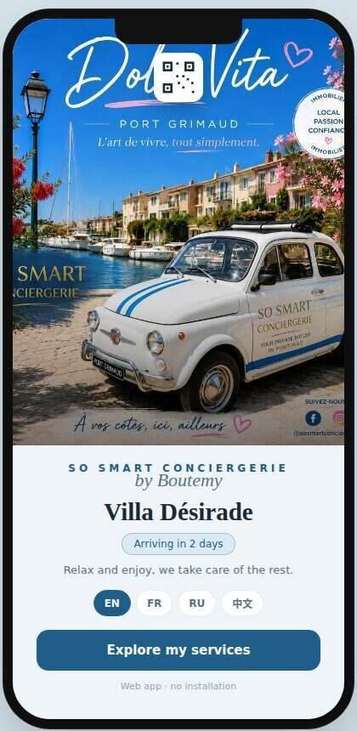
Everything below is what the guest-facing app actually does in the two working demos, generic and So Smart Conciergerie. Open the demos to see it live rather than take our word for it.
The guest opens their link and lands on a screen built around their stay: the villa name, a welcome message your agency wrote, and your brand's colors and logo instead of a generic template. It reads like a message from your agency, because it is one.

Below the welcome message, guests see the services your agency has configured: private chef, boat and skipper, spa treatments, transfers, and whatever else your agency offers, each with its own description, photo and price.
Each service shows a short description and a clear price, set by your agency in the back-office.
Services are grouped so a guest can scan quickly instead of scrolling a flat list.
Every service and the villa itself carry photos uploaded by the agency, not stock placeholders.
A guest selects a service and books it directly inside the app. Payment is collected securely on the spot via Stripe, so there is no back-and-forth by phone or WhatsApp to confirm and no separate invoice to send. See exactly how the money moves on the Payments page.
Guests can message the agency's concierge directly from the app for anything that does not fit neatly into a bookable service, a special request, a question about the villa, a change to an existing booking. How this chat is staffed can be adapted to each agency's size and needs. Majord can provide an AI-assisted chat that answers guests directly, the way a concierge agent would, for most common questions: villa information, available services, schedules, recommendations, general questions. Estimated to cover around 90% of everyday requests. For anything more specific, a restaurant reservation, a particular ask, or a service that needs a human decision, the chat sends a notification to the agency's concierge, who can then reply directly in the chat or call the guest. The goal is to combine the speed and availability of AI with human expertise wherever it adds real value.
The demos show English, French, Russian and Chinese. That list is not fixed: an agency can add any language its guests need, or remove ones it never uses, matching whichever countries it actually works with. The app adapts to the agency, not the other way around.
Each agency gets a full destination guide it can personalize with its own recommendations, addresses and experiences. The purpose is to encourage guests to download the app as early as possible, before or right at arrival, even if they do not think they need any extra services yet. It works the way hotel room service does: guests see what is available, with clear prices, and decide for themselves when they feel like using something. The idea is not to feel exclusive or reserved for very high-end clients, it is to naturally show what is possible: a boat excursion that could be fun, a private chef available tonight, a good restaurant the agency can book. Giving visibility to what is available lets guests discover things they would not necessarily have looked for on their own, which makes the destination guide both a better guest experience and a way for agencies to grow revenue through additional services and commissions.
The So Smart Conciergerie demo shows all of this configured for an actual Saint-Tropez agency.